


The HRCI Research Hub brings together original studies, workforce polling, reports, and expert analysis, so you can act on what's happening now and prepare for what's next.
The State of HR Featured ReportsRecovery as a Workforce Strategy
Drawing on HRCI research, workforce data, and expert insight, this report examines the workplace impact of substance use disorder and the practical steps HR can take to strengthen culture, manager readiness, benefits, policies, and recovery support.
.png?sfvrsn=19b9ec76_1)
Original research and expert analysis on the issues shaping HR today, from workforce safety and emerging technology to DEI and employee well-being.
From return-to-office decisions and hybrid work to contractors and other non-traditional workers, this HRCI report explores the latest research and how HR can use data to make more informed, evidence-based workplace decisions.
From career paths to culture, this research identifies what actually separates HR professionals who are just getting by from those who are truly fulfilled—and what leaders can do to close that gap and build a more committed team.
This research uncovers where professional development is falling short, from misaligned training priorities to gaps in AI readiness, and what it takes to build a workforce equipped for what's next.
From bullying, political tension to substance use and violence prevention, this research covers workplace safety—what the data reveals, what's at stake, and what you can do to reduce risk and build a more resilient organization.
The State of HR
Based on HRCI’s survey of thousands of HR professionals, the State of HR report examines the issues defining the profession today. From AI and workplace culture to talent, leadership, and career growth, the report reveals how HR teams are adapting to change and preparing for the future. Explore the data, trends, and insights shaping the world of work below.
Download the Full ReportState of HR Spotlight Reports
Half of HR professionals work in environments marked by polarized viewpoints, and 4 in 10 describe their stress as extreme or high. Find out what the data reveals about conflict, mental health, and what it means for your organization.
HR professionals are broadly optimistic about their field — but over 4 in 10 are considering careers outside of it. Explore what's driving both the enthusiasm and the tension, and what it takes to build a team of true HR believers.
71% of HR professionals use AI regularly, yet more than half say implementing new technology is the area they feel least prepared to handle. See where the preparation gap is widest and what needs to change now.
83% of HR professionals believe remote work benefits organizations—but the debate is far from settled. Get the data on where HR stands on flexibility, productivity, and the return-to-office conversation.

More Insights for HR Professionals
Explore the issues shaping HR today and get the data you need to lead with confidence, make informed decisions, and move the profession forward.
Recovery friendly workplaces reduce absenteeism, improve retention, and strengthen workplace culture—yet most organizations haven't made meaningful progress. This HRCI and Fors Marsh research reveals why: stigma, undertrained HR teams, and weak leadership buy-in top the list. Understand where the gaps are and what organizations that get it right do differently.
Earning an HRCI certification builds earning power. Within four years, the median HRCI certificant earns 33% more than they did before getting certified. That's double the salary growth of comparable HR professionals over the same period. See what the data shows about the career and financial impact of HRCI certification.
HR is ready to lead, but is the organization ready to let it? This 2024 HRCI and MindEdge research report surfaces a striking disconnect: while 88% of HR professionals believe HR should drive business strategy, only half say leadership agrees. Add in underfunding, understaffing, and persistent burnout, and the case for rethinking HR's role has never been stronger.
AI is reshaping the workplace, and HR professionals are watching closely. This HRCI and MindEdge survey of HR practitioners reveals how the profession is navigating AI adoption, persistent burnout, rising turnover, and the evolving push and pull of remote work. Find out where your peers stand, and what the data means for the work you do every day.
Browse our complete library of research reports, guides, and frameworks. Whether you're building a business case, navigating a workforce challenge, or staying ahead of what's next, the intelligence you need is here.
From rising absenteeism to safety risks, HRCI research reveals how extreme weather is reshaping workforce management and what HR can do now.
Over three-quarters of HR professionals use AI weekly, but most have had little to no training. Learn how to build real confidence and capability starting today.
Explore how HR can turn AI adoption into a strategic advantage—balancing innovation with ethical responsibility.
This research-backed guide gives HR professionals the data and practical steps to build a recovery-friendly culture that reduces risk and supports your people.
The report explores the realities of managing DEI programs in today’s climate—where values alignment, stakeholder trust, and business performance are all on the line.
This report provides critical insights and actionable strategies for HR leaders to foster a more harmonious and productive work environment.

HRCI webinars go beyond the basics. Each session unpacks the trends, data, and real-world strategies HR professionals need to lead with confidence today and adapt to what's coming next.
News and perspectives on the issues driving the HR profession forward.
In a recent Harvard Business Review article, author Ron Ashkenas labeled agility the “leadership superpower.” His article begins, “One of the most lauded leadership characteristics today is the ability to pivot—to change course quickly when a planned path is blocked or revealed to be disadvantageous. This kind of rapid adaptation, often referred to as agility, is critical in a fast-changing environment or when innovating in unknown territory where old behaviors and management practices no longer work.”
I agree that agility is an extremely important skill for today’s leaders. I also believe that in addition to the change and innovation-centered context described by Mr. Ashkenas, leadership agility is needed in addressing the wide-ranging, people-centered challenges leaders face nearly every day. In today’s tumultuous workplace—where so many situations are complex, uncertain, and highly fluid—leaders must be open to new ways of thinking and working. Instead of leadership agility being characterized as a rare superpower, I think we need to begin thinking of it as a fundamental leadership competency.
Agility in a leadership context involves taking action and making decisions that move the business forward in the face of uncertainty and change. It requires creativity, flexibility, and innovation as well as deliberate action. It relies on a leader’s ability to manage change, conflict, and resources to solve problems and achieve goals.
Over the last year, my colleagues and I at Dion Leadership have been researching and studying leadership agility. Our findings consistently show that agility is a connector skill, or ultimately, an outcome of the application of a set of competencies—a “meta-competency” of sorts.
Leadership agility connects to these important skills:
Flexibility
Adaptability
Mindfulness
The ability to act with incomplete information And like all leadership skills, it can be developed.
So how do we, as human resource professionals, develop our leadership agility? And how do we help the leaders in our organization develop their agility skills?
Leadership agility is about creating space in your brain so that when faced with circumstances that are new, changeable, and uncertain, you’re more likely to respond thoughtfully, rationally, and with intent.
This simple yet comprehensive model will help.
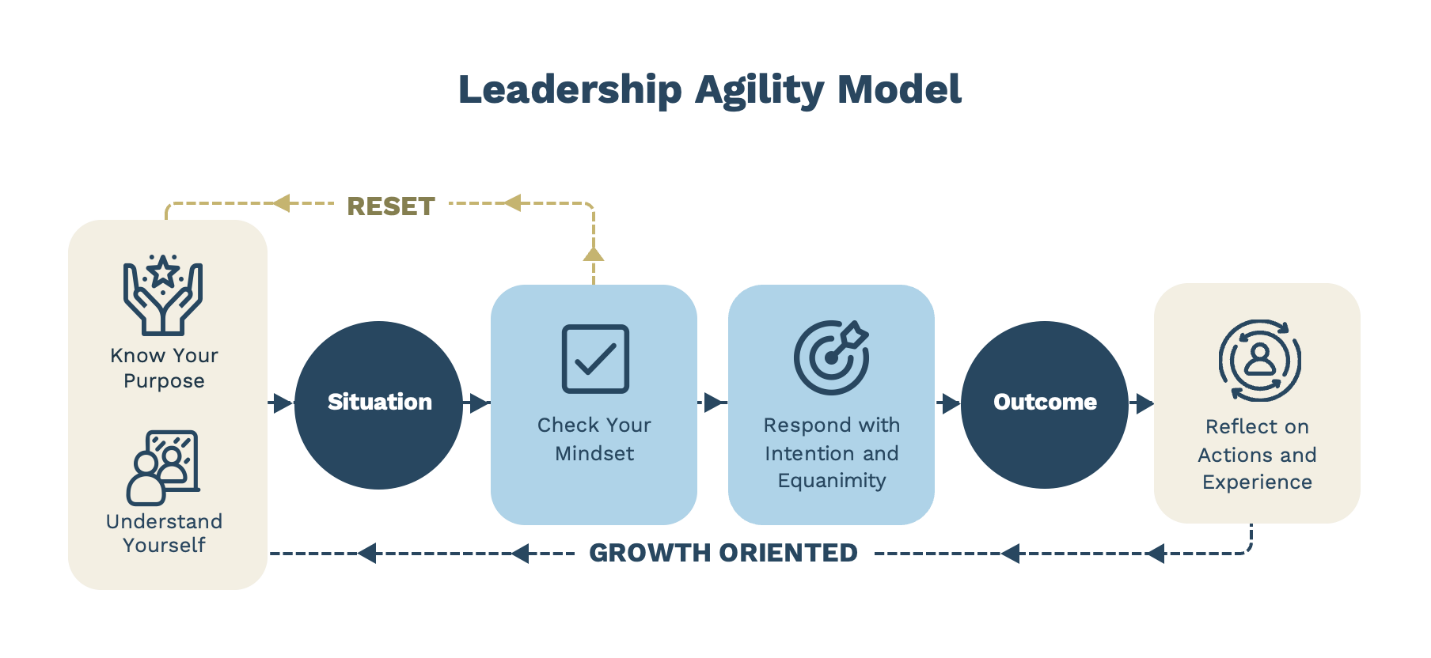
You’ll notice that this model is circular, indicating it is a development process designed to be repeated. The illustration also shows that developing your leadership agility is primarily a self-reflective process.
The first steps are knowing your purpose within your team or organization and understanding yourself. Knowing your purpose is about grounding yourself in what needs to be accomplished and the parameters that guide projects, initiatives, and even the organization overall.
Similarly, understanding yourself requires clarity on what you bring to the situation as a leader—your personal style and tendencies, comfort zone, and strengths and limitations, as well as knowledge of what drives you, what stresses you, and other qualities that inform your self-awareness.
The middle section is about what happens when you’re faced with a situation that will call on your leadership agility to drive favorable outcomes. This involves checking the mindset that you bring to the situation. This in-the-moment analysis considers whether your mindset aligns with the achievement of a productive, effective outcome that benefits you, the initiative, and the organization. If it doesn’t, you will need a reset so you can respond to the situation in a way that is thoughtful, intentional, deliberate, equanimous, and compatible with a positive result. Returning to what you know about your purpose and yourself can inform this mindset shift before taking action to facilitate the outcome.
What closes the circle is reflection on lessons learned about the process and your behavior. With a spirit of self-awareness and growth orientation, this reflection further refines your purpose and mindset.
How would you rate your leadership agility competency? Consider these questions:
Is the work I do grounded in the company’s purpose, goals, and values?
Is the work I do day-to-day guided by my personal sense of purpose in my role, goals, and values?
Do I regularly focus on improving my emotional intelligence?
Am I able to be productive and effective in uncertain or changeable work situations?
Do I regularly step back and consider a broader perspective when I approach work challenges and opportunities?
Do I check in with my mindset as part of my approach to workplace challenges and opportunities?
Would I typically describe my mindset as growth oriented?
Am I willing to consider new ways and ideas, even if they are not my own and are outside my comfort zone?
Am I willing to be flexible, even if it means I might make mistakes or give up control of a situation?
Do I seek to respond with intention to workplace challenges and opportunities?
Do I regularly reflect on my work actions and experiences so I can learn from them?
Becoming a more agile leader is an ongoing process. Like any competency, it takes practice and focus, as well as humility and patience, because it often requires us to behave in ways that are not intuitive or comfortable. Nevertheless, agility is necessary for leaders who want to be successful in a business world that is increasingly unpredictable, changeable, and interdependent.
If you’d like to learn more about leadership agility, I invite you to check out the recording of my HRCI Alchemizing HR webinar titled “Leadership Agility: A Critical Skill Your Leaders Need to Know.” We also created a Leadership Agility e-book that is available for download. Please enjoy these additional resources. Good luck developing your leadership agility!
Joe LaDuke is Vice President, Coaching & Consulting Services at Dion Leadership.He partners with organizations to craft solutions to their leadership and organizational development needs.