


Providing HR professionals with the latest industry news, best practices, and thought leadership to help navigate the ever-changing landscape of human resources.



Substance use disorder (SUD) is one of the most pressing challenges facing today's workforce. Whether openly discussed or kept private, it is present in every workplace and its impact is significant. Workers with SUD take nearly 50% more unscheduled days off and have a 44% higher turnover rate than the general workforce, creating real costs in productivity, healthcare, and retention.
Many organizations remain underprepared. Only 13% have formal policies around treatment and recovery, and just 3% offer dedicated training for HR employees. For every person struggling, two or three colleagues or family members around them are affected by SUD too.
"The numbers tell us that substance use disorder is an issue every organization will confront. Smart employers will get out front and support employees on their journey to recovery."
Amy Dufrane, SPHR, CEO, HRCI
The good news is there are solutions. Employers and employees can work together to cultivate a recovery-friendly environment with policies and practices that align with organizational values.
On a recent webinar, HRCI welcomed leaders from the National Recovery Friendly Workplace Institute, Gorilla Glue Company, and Associated Builders and Contractors to discuss the ROI of recovery-friendly workplaces. Panelists shared their "why" behind getting certified as a recovery-friendly workplace. They detailed how it met the needs of their employees and how it aligned with their values as an organization. In addition, they shared the measurable benefits to their employees and organizations.
Here is how HR leaders can take a proactive approach to adopting a recovery-friendly workplace.
It begins with a leadership commitment. HR is uniquely positioned to drive this change by aligning existing policies, equipping managers, and fostering a culture of support.
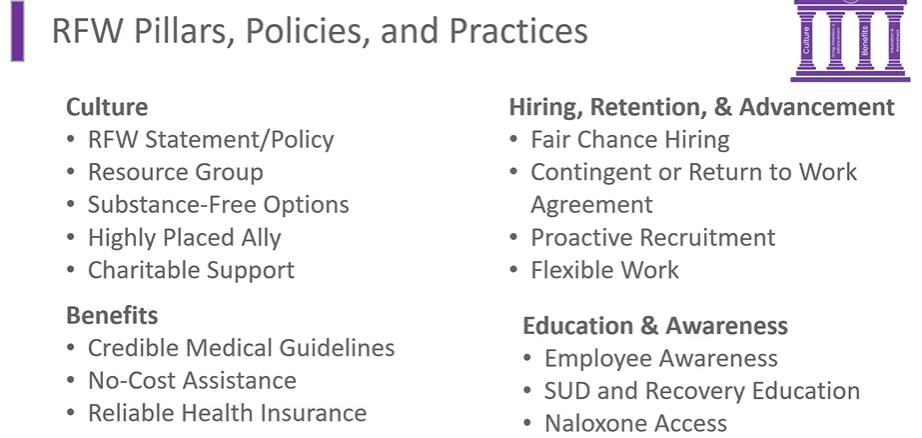
The steps to creating a recovery-friendly workplace start with improving communication and coordination of existing resources rather than creating an entirely new program. These insights highlight a practical path forward for HR leaders.
Managers are most likely to notice a change in employee behavior. With the proper training, managers can connect employees to available resources and support programs.
While there is no one-size-fits-all approach, HRCI's Becoming Recovery Friendly white paper shows that effective manager and employee training often covers:
With this framework, managers can support and advocate for employees in recovery, ultimately leading to systems and processes that cultivate a supportive culture.
Organizations that adopt recovery-friendly workplace practices often see measurable benefits including:
One concrete step HR leaders can take is pursuing certification as a Recovery Friendly Workplace. The National Recovery Friendly Workplace Institute offers certification for organizations that want to formally commit to supporting employees in recovery. Since its rollout in late 2023, nearly two dozen organizations—ranging from small teams to companies with as many as 85,000 employees—have earned certification. HRCI was among the first.
Recovery-friendly workplaces are not just good for employees; they are good for business. By committing to supportive policies, equipping managers, and reducing stigma, HR leaders can build organizations where people in recovery can thrive and contribute fully. The path forward starts with a single step: deciding that your workplace will be one that supports recovery.
Related Resources
HRCI White Paper: Becoming Recovery Friendly
HRCI ENGAGE: Workplace Substance Abuse & Recovery